Rivers and Cities: Reclaiming the Right to Water
Development
Water is the source of life. Rivers are the ancient arteries of the planet—the cradle of civilizations and silent witnesses to human history. Yet today, this relationship is on the verge of rupture. Cities either turn away from rivers, shielding themselves from floods with concrete embankments, or exploit their banks indiscriminately, fragmenting them into a patchwork of privatized developments. Is there a middle ground? We conducted a comprehensive study of the relationship between rivers and cities and developed a roadmap for restoring this lost balance. This is not merely a collection of data, but both a manifesto and a practical guide for urbanists, policymakers, and engaged citizens seeking to restore rivers to their rightful place in contemporary urban life.
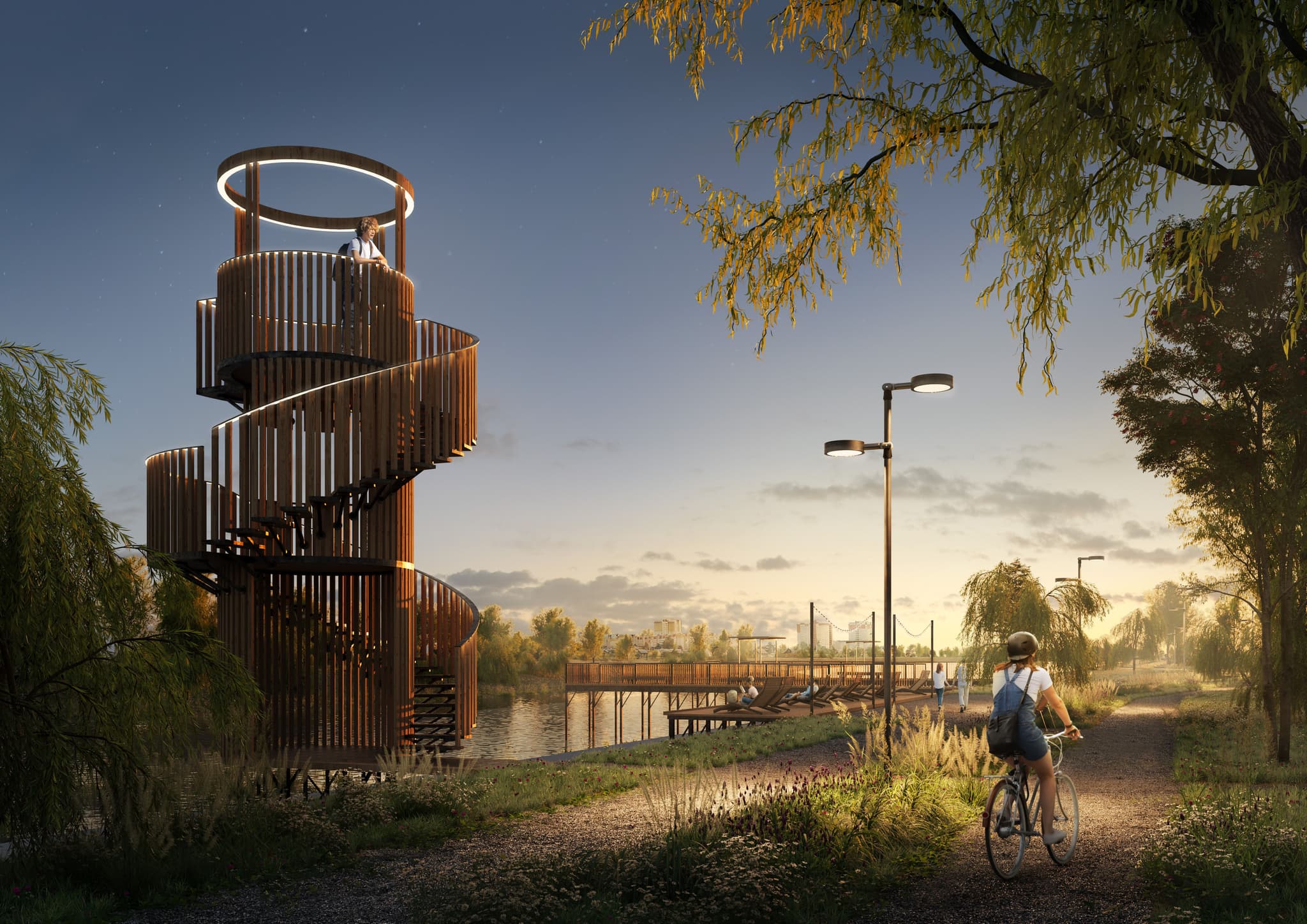
A Shared Objective
At the outset of our research, we posed a central question: Is it possible to build a healthy relationship between rivers, cities, and their inhabitants while balancing the interests of all? This question became the guiding objective of the study. The answer may seem straightforward, but it entails a profound shift: moving beyond the centuries-old paradigm in which rivers were viewed either as inexhaustible resources or as threats. Today, the river must be understood as a living, integrated system—one whose “rights” and interests must be considered alongside economic and social priorities.
Methodology
Global Data Analysis We analyzed data from sources such as the World Bank, NASA, and numerous scientific publications, demonstrating that 72% of the global population lives within major river basins. In countries such as Tajikistan and Kyrgyzstan, this figure reaches 95–99%. Historical Perspective The relationship between cities and rivers has evolved from sacred unity in ancient times, through industrial confrontation, to today’s phase of restoration—and toward a future of partnership. Comparative Analysis We examined more than 20 international case studies—from Stockholm and Istanbul to Chicago and Seoul—to identify the most effective contemporary approaches to working with water systems. Expert Insights The study incorporates interviews with Russian and international experts, offering perspectives on both successes and ongoing challenges in urban–river interaction.
Key Findings: What Data and Practice Reveal
1. The River as a Foundation for Sustainable Urban Development Research shows that 14 of the 17 UN Sustainable Development Goals are directly linked to the health of rivers. These include access to clean water, ecosystem preservation, public health, economic growth, and urban resilience. Rivers function as critical natural infrastructure, simultaneously supporting environmental, economic, and social systems. As Ekaterina Andrusenko (PhD Candidate, Delft University of Technology) notes: “Rivers are losing their historical role as transport routes and energy sources. Our goal is to restore their natural hydrological state, as they remain essential ecological elements of the urban environment.”
2. From Reverence to Conflict—and Toward Repair The evolution of human–river relationships can be understood in four stages: Unity (Ancient and Medieval periods): rivers as sacred lifelines—sources of food, energy, and transport; a balanced relationship. Conflict (Industrial era): rivers reduced to resources and waste channels; channelized, controlled, and degraded; access becomes restricted. Restoration (Present day): recognition of past mistakes; cities reopen waterfronts, launch renaturalization programs, and acknowledge the “right to water.” Partnership (Future): rivers as drivers of sustainable development and mediators between technology and nature.
3. Rivers and Human Health: Scientific Evidence Our review of 39 studies shows that 36 confirm the positive impact of blue-green environments on both physical and mental health. Visual contact with water reduces stress, anxiety, and depression. Waterfronts and water-based activities encourage physical movement, while time spent near water enhances cognitive restoration and creativity. A notable example is the UK’s “Green Prescription” program, where doctors prescribe activities such as riverside walks and gardening to patients with anxiety and depression.
4. A Broad Toolkit: From International Agreements to Nature-Based Solutions We structured the full range of interventions into a Conceptual Balance Framework, comprising two main направления: Working with the River System Institutional governance, particularly for transboundary rivers such as the Danube, Amazon, and Nile International cooperation frameworks to mitigate water-related conflicts Ecosystem restoration projects, including renaturalization (e.g., the Border Meuse project in the Netherlands, which restored the river to a state resembling its condition 500 years ago) Working with Waterfronts Nature-based engineering solutions replacing rigid бетонные embankments with adaptive systems such as gabions, wetlands, and permeable structures Blue-green infrastructure strategies that connect water and green spaces into integrated networks (e.g., the London Green Grid, covering over 500,000 hectares) Integrated development strategies that balance flood protection, economic use (e.g., Galataport in Istanbul), and guaranteed public access (e.g., the 30-year Great Rivers Chicago program)
5. An Atlas of Ideas: Innovation at the Intersection of Disciplines Beyond conventional approaches, emerging experimental solutions point toward the future of river–city relationships: Pavement materials made from river sediments (Rotterdam) Oyster reefs as natural breakwaters (New York) Floating water purification systems using algae Floating housing and public spaces (Copenhagen) These initiatives demonstrate that restoring rivers requires not only funding and regulation, but also creativity—and that progress can begin today.
Not a Conclusion, but a Forward Outlook: Building Bridges, Not Barriers
The “Rivers and Cities” study leads to a clear conclusion: while there is no universal formula, there is a shared principle. Success depends on treating ecological river health, human needs, and urban economic interests as parts of a single system. A river is not a boundary, but a connector. Not a problem, but a solution. Its restoration is not merely a matter of landscaping—it is a question of quality of life. As expert Irina Shmeleva states: “Water in the city is life… and waterfronts are the means by which we can reorient cities toward nature-based design.” A future in which cities coexist in partnership with their rivers is entirely achievable. This research provides a detailed and inspiring roadmap toward that future. The full version of the study, including case studies, interviews, and visualizations, is available at: https://rivers.buroatlas.pro

Ready to collaborate?
We’re here to take on your challenge — just write to us.