Children’s Street Retail: How Child-Oriented Infrastructure Is Reshaping the Image and Economics of Contemporary Residential Developments
Beyond Conventional Landscaping
Date
23.03.2026
Share
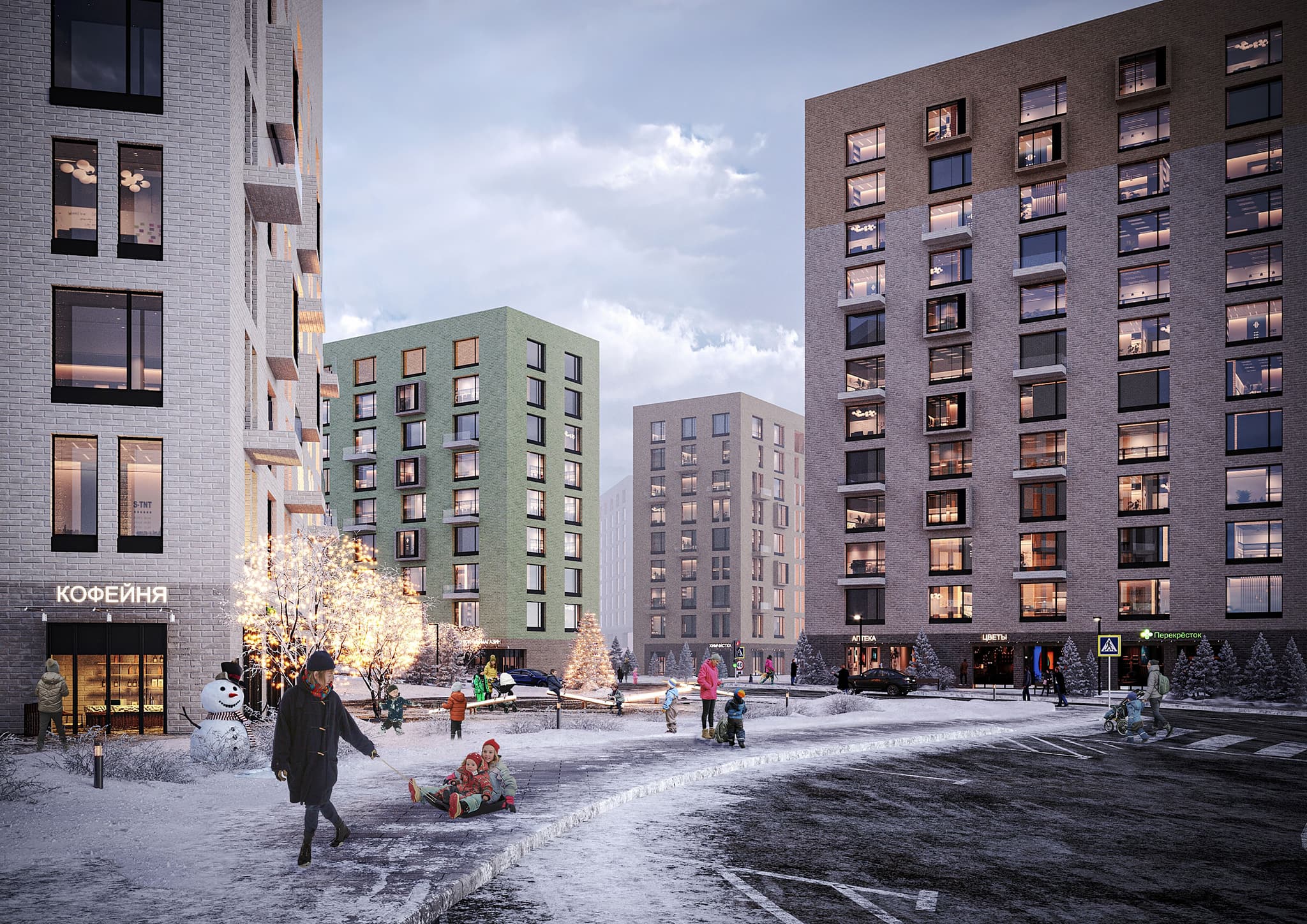
Families with children are one of the key buyer segments in the new-build housing market. Today, however, children are no longer seen merely as part of the client family, but as an independent and demanding audience: full-fledged users of the environment and active consumers of commercial services. In response to this demand, a new niche is expanding within Russian development—children’s street retail: commercial premises within residential complexes geared toward education, leisure, and entertainment for young residents. According to industry experts, the segment has grown by an estimated 15–25% annually over the past three to five years. This trend is not simply a marketing device, but part of a broader strategy of product differentiation, particularly in the highly competitive economy and comfort segments. As Olga Antonova, Commercial Real Estate Director at Samolet Group, notes, their research shows that more than 60% of buyers pay attention to landscaping, playgrounds, and leisure infrastructure for children, while 50% specifically highlight the availability of educational and entertainment services.
Why Children Have Become the Primary “Clients” of the Environment
Developers no longer treat children as passive participants. “A significant share of our clients come to apartment selection meetings with their children. And children are engaged with on equal terms, because for them many projects can seem like relics of the past,” confirms Oksana Diveeva, Sales Director at Capital Group. Children influence purchasing decisions, which means the environment must respond to their needs here and now. This shift has led major developers to actively design and launch their own branded products for children: Samoletum schools (Samolet Group), Learnity centers (A101 Group), and Kids Club formats in Park Towers projects. These formats are becoming a competitive advantage and contribute to long-term resident loyalty.
Benefits for the Project: Footfall, Conversion, and Synergy
Integrating child-oriented services into the structure of a residential development is a valuable investment in activating ground-floor retail for several reasons. 1. Pedestrian footfall generation Children’s clubs, classes, sports sections, and play centers create a steady flow of parents and children several times a day. This increases footfall and conversion rates for neighboring commercial units. 2. Synergy with “adult” retail As A101 Group points out, child-oriented businesses work especially well in combination with family cafés, beauty salons, pet stores, and bookstores. While a child is attending a class, parents can spend time and money on adjacent services. 3. Activation of constrained locations Children’s formats can function successfully in areas with regulatory restrictions, for example near schools where the sale of alcohol or tobacco is prohibited. They fill niches that are inaccessible to other business types. “Children’s businesses generate pedestrian traffic, so it becomes easier to sell adjacent premises, and the funnel for neighboring units immediately expands,” explains Olga Antonova.
Challenges for Developers: Requirements, Standards, and Economics
Despite its potential, working with children’s retail involves a number of challenges that slow its large-scale adoption. 1. Specific spatial requirements Operators need premises with high ceilings, white-box finishes, expanded entrance zones, and mandatory staff parking. There are also strict sanitary regulations: for example, children’s sports halls or medical rooms cannot be located above underground parking without an intermediate technical floor. 2. Lack of shared standards “There are no detailed requirements for private, non-municipal children’s facilities. Developers also build spaces without fully understanding what functions they will ultimately accommodate,” says Oksana Diveeva. As a result, each technical brief has to be developed individually in dialogue with the future tenant. 3. Complex economics and low margins Children’s businesses rarely generate сверхприбыль and are often run by parent-entrepreneurs driven more by commitment than by scale economics. This makes tenants highly sensitive to rental rates and requires a carefully calibrated pricing policy from the developer, sometimes including preferential terms at the start.
The Future: From Individual Facilities to Ecosystems
The future of this segment lies in creating integrated ecosystems rather than isolated services. This means a well-designed pedestrian and recreational framework in which children can move safely from home to school, clubs, and play spaces. Ilya Kurbatov, Head of the DEVIZHEN direction, notes: “When developing master plans, we create a framework that allows children to reach school without crossing carriageways. We design playgrounds based on an adjacency matrix of different user groups.” Experts see the greatest potential in hybrid formats at the intersection of education, entertainment, and sports—such as edutainment and STEM centers—which are capable of competing with online leisure. At the same time, there remains an underserved “gray zone” of teenagers over 14, whose needs change rapidly and require separate study. Children’s street retail is no longer an optional component of a residential complex; it has become a strategic instrument of competition. It addresses several objectives at once: enhancing a project’s appeal to families, activating commercial ground floors, and contributing to community-building within the neighborhood. Its success depends on the developer’s ability to work proactively: not merely to provide space, but to co-design specialized premises with operators, anticipate synergies between tenants, and embed children’s infrastructure into the overall concept of a safe and comfortable environment. As Alexandra Tarkhanova, Projects Director at Atlas, summarizes: “With the right synergy, a resilient ecosystem for children can emerge. This is a significant competitive advantage for any residential project.” The development of this niche is a clear example of how real estate development is evolving—from simply building housing to creating comprehensive living environments that take into account the needs of all residents, including the youngest.

Ready to collaborate?
We’re here to take on your challenge — just write to us.