A New Development Code: How District Programming Enhances Quality of Life and Creates Competitive Advantage
Development
Date
23.03.2026
Share
Today’s development market is facing a dual challenge: buyer expectations are evolving, while the economic environment is becoming increasingly unpredictable. Under these conditions, traditional approaches to territorial planning are losing their effectiveness. Buyers are no longer focused solely on price—they are placing greater value on environmental quality, lifestyle scenarios, and the distinct identity of a neighborhood. In response, developers are seeking new tools to generate long-term value. One such tool is a product-oriented approach to master planning, where a territory is programmed as a cohesive, strategically defined brand.
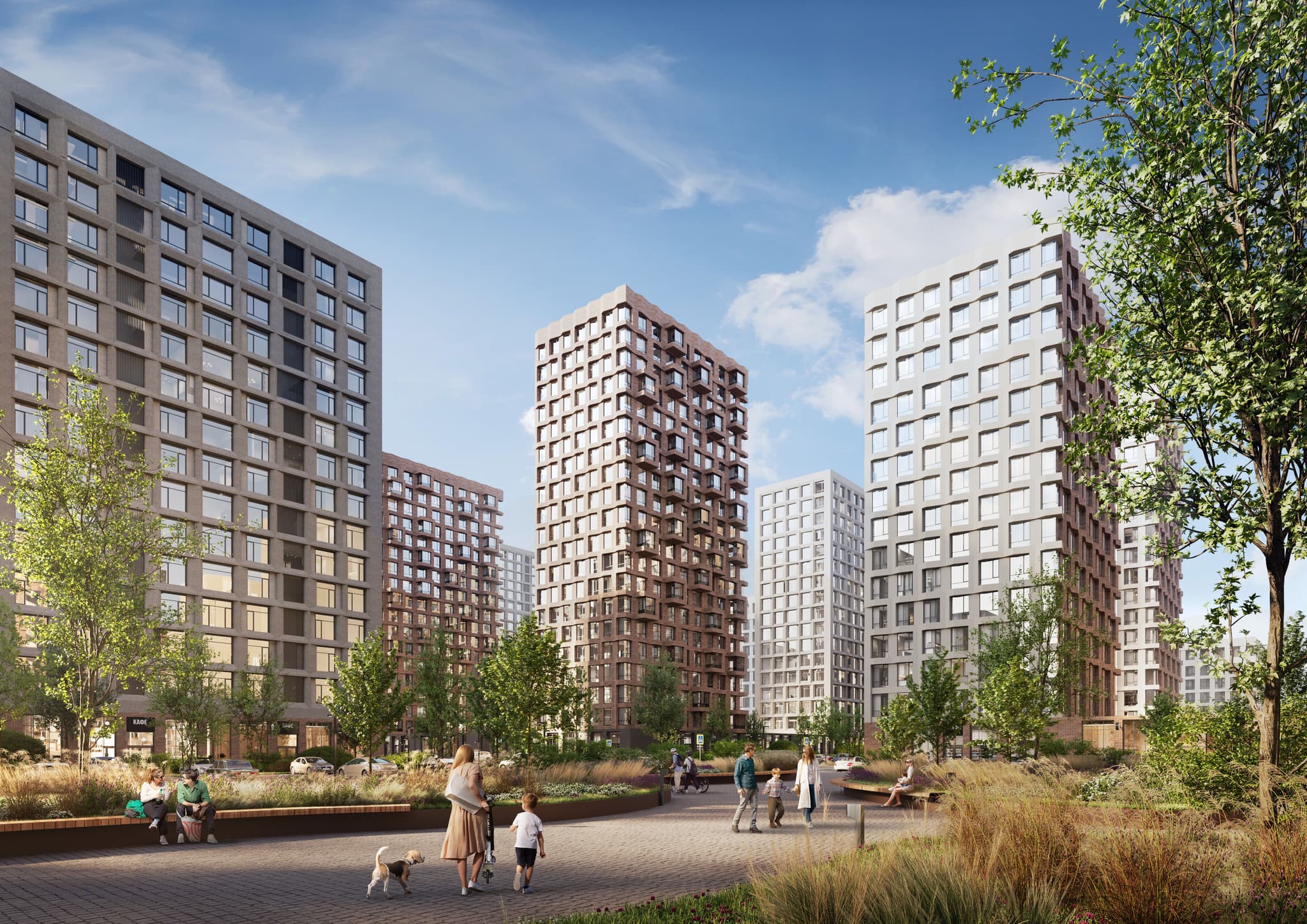
Strategic Programming: From Meaning to Value
At the core of this approach lies the stage of meaning programming. This is where the foundation of the future district is established—its concept, identity, and key values. Despite its name, this process is highly practical and addresses critical questions that help developers differentiate their projects while ultimately improving quality of life: How will the territory be positioned in the market? What lifestyle will it offer residents? How will it integrate into the city’s economic and cultural context? At this stage, the project’s strategic core is formed—a conceptual matrix that unifies architecture, functions, and communication into a coherent system. This approach minimizes arbitrary decisions and creates a manageable environment in which every element responds to real user needs. Skipping this stage in master planning is a critical mistake.
Cluster Model: Environment as a System of Opportunities
However, answering these questions is not enough—they must be embedded into the spatial structure. This is achieved through a functional organization model, or more simply, a cluster-based approach. It is built on the principles of polycentricity and a controlled hierarchy. Unlike traditional zoning, where functions are strictly segregated, the cluster model enables the creation of interconnected spaces unified by shared themes.
For example, in a new district project in Volgograd developed in collaboration with DARS, we implemented a model of five thematic clusters:
education
nature
sports
community
technopark
The nature cluster includes not only parks and green corridors, but also the integration of residential development with landscape elements such as sensory gardens, wellness zones, and walking routes—transforming the natural environment into an active resource for everyday life. Clusters are supported by a hierarchy of functional elements: Key anchors — strategic centers of attraction that define the identity of the territory Local nodes — smaller yet essential spaces that enhance everyday livability This structure ensures an even distribution of activity, eliminates “dead zones,” and creates conditions for sustainable district development.
Architecture as an Extension of the Concept
Architectural and planning solutions become tools for expressing and implementing strategic ideas. They serve three key functions:
1. Embodying Identity Architecture communicates the values of the territory through façades, materials, and landscape design. Building typologies reflect cluster concepts: a technological cluster through glass and dynamic forms, a nature cluster through timber and landscape integration. Landmark buildings and art installations create memorable focal points.
2. Programming Lifestyle Scenarios Planning solutions shape user behavior through: A hierarchy of development (building heights decreasing from centers to periphery) Flexible ground floors accommodating retail and services A pedestrian and transport network ensuring access to infrastructure within a 15-minute radius The spatial structure encourages specific patterns of use. Variable density, active ground floors, and a well-designed circulation network support the principles of the “15-minute city.”
3. Ensuring Long-Term Resilience Long-term value is achieved through: Adaptable layouts allowing functional transformation Energy-efficient technologies and high-quality materials Durable structures that reduce operational costs Modularity, spatial flexibility, and material quality lower maintenance costs and preserve asset value. Architecture thus becomes an investment in liquidity and longevity.
Investment Parcels as Independent Products
Large-scale developments are rarely implemented all at once. Dividing a site into investment parcels enables phased development while maintaining strategic coherence. Within this approach, each parcel is treated as an independent product with a defined function and value.
Key principles of working with parcels:
1. Functional Autonomy Each development phase is designed as a self-sufficient unit with a complete environment. The presence of public spaces, services, and attractors allows it to function effectively upon completion, without waiting for the entire project to be realized.
2. Strategic Phasing Territorial development follows a clear сценарий, where each phase addresses specific objectives. Key identity-forming elements are delivered first, followed by residential and commercial components. This ensures controlled value growth and minimizes risk.
3. Unity in Diversity While each parcel retains its individuality, all adhere to common rules—shared architectural guidelines, materials, and design codes. This creates a cohesive urban identity while allowing functional diversity.
This approach transforms a territory into a managed ecosystem, where each component contributes to a unified strategy. It enables developers to maximize returns at every stage of implementation. At Atlas, we have adapted our methodology to current challenges by embracing product thinking in master planning. Our experience shows that this approach creates environments that retain long-term value and attractiveness, enhance quality of life, and provide developers with a clear competitive edge.

Ready to collaborate?
We’re here to take on your challenge — just write to us.